
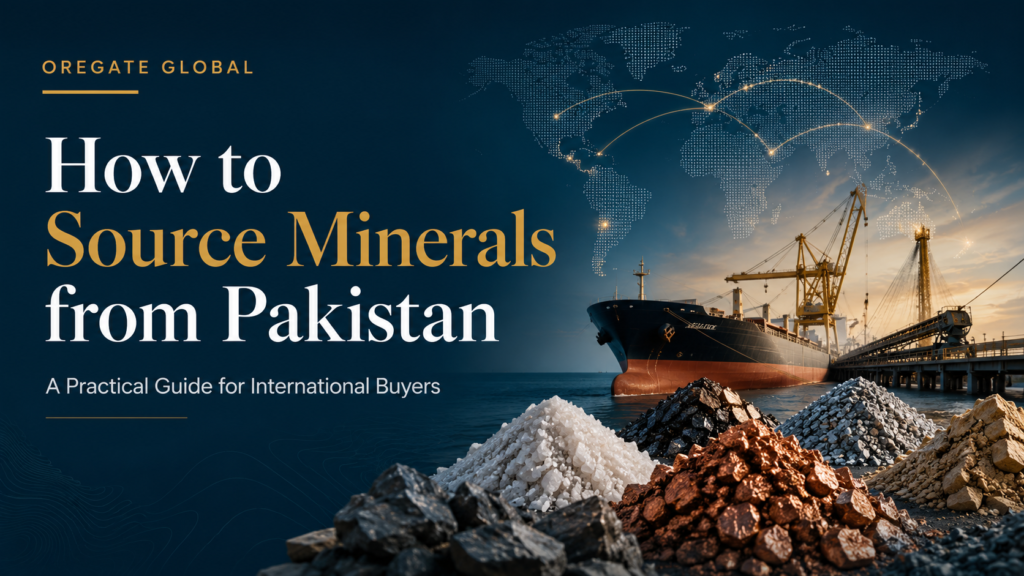
Pakistan offers a broad range of mineral and mineral-based products, but successful procurement depends on much more than locating a seller. International buyers need a specification-led process that connects supplier capability, representative testing, commercial terms, documentation, and logistics.
International buyers searching for a Pakistan mineral exporter often begin with a commodity name: iron ore, bauxite, gypsum, limestone, copper-bearing material, coal, fluorspar, pink salt, or industrial salt. That is a reasonable starting point, but it is not enough to support a reliable transaction. The same mineral name can cover widely different chemical compositions, particle sizes, moisture levels, processing methods, packaging formats, and end-use suitability.
The safest way to source minerals from Pakistan is to treat the purchase as a controlled technical and commercial process. A buyer should define what is required, establish how conformity will be measured, identify suppliers capable of meeting the requirement, verify the material, and then align shipment responsibilities and documents before committing to an order.
Why Pakistan Attracts International Mineral Buyers
Pakistan’s mineral sector includes metallic minerals, industrial minerals, construction materials, coal, and salt. The Trade Development Authority of Pakistan has identified minerals as an export sector and reports a range of commercially relevant deposits and products. For an international buyer, the opportunity is not simply access to natural resources; it is the ability to locate a grade, process, and supply arrangement that fits a specific industrial use.
Pakistan-origin materials may serve construction, cement, steelmaking, foundry, ceramics, glass, chemicals, agriculture, water treatment, food processing, animal feed, wellness, decorative, and other applications. However, origin alone does not establish suitability. A credible sourcing process must avoid broad promises and work from measurable requirements.
Step 1: Build a Clear Purchase Specification
A purchase inquiry should describe the material in a way that a supplier, laboratory, inspector, freight forwarder, and buyer’s technical team can all interpret consistently. Vague requests such as “high-grade iron ore” or “best quality salt” create room for misunderstanding. A structured specification reduces that risk.
- Product and intended application: state how the material will be used, because acceptable chemistry and physical properties depend on the process.
- Chemical composition: define minimum, maximum, or typical values for the relevant constituents and impurities.
- Physical requirements: include particle size, lump or powder form, moisture, density, color, hardness, or other application-specific properties.
- Quantity and delivery program: specify trial quantity, monthly requirement, annual estimate, and whether deliveries are one-time or recurring.
- Packaging: identify bulk, loose loading, jumbo bags, woven bags, lined bags, retail packs, pallets, or container requirements.
- Destination and logistics: include destination port, final delivery point, preferred shipment mode, and expected delivery window.
- Inspection and testing: identify the laboratory, test method, sampling point, acceptance criteria, and who pays for verification.
- Commercial basis: request the preferred Incoterm, currency, quotation validity, payment structure, and required documents.
A technically complete inquiry usually receives a more useful quotation than a request based only on a commodity name and target price.
Step 2: Qualify the Supplier and Processing Route
Supplier qualification should cover both the commercial entity and the physical supply chain. A trader may coordinate reliable material from a mine or processor, while a mine owner may still depend on outside crushing, screening, washing, grinding, packing, or transport. Buyers should understand who controls each stage.
- Confirm the legal name, address, responsible representatives, and export capability of the contracting party.
- Identify the source location and whether the material comes from one deposit or multiple supply points.
- Review available production, processing, stockpiling, and packaging capacity against the requested schedule.
- Ask how lots are segregated and how consistency is managed between shipments.
- Confirm whether the supplier can support samples, third-party inspection, weighing, loading supervision, and documentation.
- Check whether destination-country restrictions, sanctions, permits, food rules, environmental requirements, or special certifications apply.
Step 3: Use Representative Samples and Agreed Test Methods
A sample is valuable only when it represents the material that may actually be supplied. A hand-selected specimen can look impressive while providing little information about a commercial lot. Buyers should agree how the sample will be collected, prepared, sealed, labelled, transported, and tested.
For larger or recurring transactions, it may be appropriate to distinguish between an initial reference sample, a pre-shipment sample, and the final shipment sample used for acceptance or settlement. The contract should state which result controls if the supplier’s certificate and the buyer’s receiving analysis differ.
Laboratory competence also matters. ISO/IEC 17025 provides an international framework through which testing and calibration laboratories can demonstrate competence and the ability to generate valid results. The selected laboratory’s accreditation scope should be relevant to the actual test, not merely to unrelated laboratory activities.
Step 4: Compare Quotations on the Same Basis
The lowest headline price is not necessarily the lowest delivered cost. Two quotations may differ in grade, moisture basis, sizing, packaging, inland transport, port charges, inspection scope, freight, insurance, documentation, and risk allocation. The buyer should normalize the offers before comparing them.
| Quotation Element | Questions to Confirm |
|---|---|
| Price basis | Is the price per wet metric ton, dry metric ton, bag, container, or another unit? |
| Quality basis | Which assay, size, moisture, and impurity limits are included? |
| Quantity tolerance | What shipment tolerance is permitted and how is it invoiced? |
| Packaging | Is packaging included, and what are the bag, liner, pallet, or marking specifications? |
| Inspection | Who appoints and pays the inspector or laboratory? |
| Delivery term | Which Incoterms® 2020 rule and named place or port apply? |
| Validity | How long is the quotation valid, particularly where freight or commodity prices move? |
| Documents | Which certificates and shipping documents are included? |
Step 5: Select the Right Shipment and Incoterm Structure
Incoterms® rules clarify defined delivery obligations, costs, and risk transfer between seller and buyer. They do not determine product quality, payment timing, ownership transfer, remedies, or every document required under the sale contract. Those points must be addressed separately.
For mineral transactions, buyers frequently encounter FCA, FOB, CFR, CIF, or DAP. The correct choice depends on whether the cargo is containerized or bulk, where the seller can practically deliver it, who controls freight, whether insurance is required, and where the buyer wants risk to transfer. The contract should state the rule, the precise named place or port, and “Incoterms® 2020.”
Step 6: Agree the Export Document Package
Documentation requirements vary by commodity, shipment mode, payment method, importing country, and contract. A typical package may include a commercial invoice, packing list, certificate of origin, bill of lading or transport document, certificate of analysis, weight certificate, inspection certificate, insurance document where applicable, and any product-specific or regulatory documents.
The buyer should approve required wording before shipment. Differences in consignee details, product descriptions, HS codes, weights, marks, bank instructions, or certificate language can cause customs delays or document discrepancies.
Common Mineral Sourcing Risks
- Buying against a generic product name without measurable acceptance criteria.
- Accepting a sample that was not collected from a representative lot.
- Relying on a certificate without confirming the laboratory, method, date, and sample identity.
- Comparing prices quoted on different moisture, quality, packaging, or freight bases.
- Leaving the destination port, named place, or Incoterm version unclear.
- Assuming a food, feed, chemical, or construction application is approved without checking destination rules.
- Committing to a large order before the supplier demonstrates consistency through a trial or controlled first shipment.
- Treating export coordination as a substitute for a complete written sales contract.
A Specification-Led Sourcing Workflow
- Buyer submits the commodity, end use, specification, quantity, sizing, packaging, destination, delivery basis, and inspection expectations.
- Potential supply options are screened against the stated requirements and commercial feasibility.
- Clarifications, indicative quotations, samples, or technical documents are coordinated where appropriate.
- The parties agree sampling, testing, acceptance, quantity, price, payment, Incoterm, documents, and shipment schedule in writing.
- Inspection, processing, packing, inland transport, export documentation, and loading are coordinated according to the contract.
- The buyer reviews the shipment documents and follows the agreed receiving, claim, or final acceptance procedure.
Frequently Asked Questions
Can international buyers purchase directly from Pakistan mineral suppliers?
Yes, subject to the supplier’s export capability, the commodity, applicable laws, banking arrangements, destination requirements, and agreed contract terms. Some buyers work directly with a producer, while others use a sourcing and export coordination company to manage communication across suppliers, processors, inspectors, and logistics providers.
What information should I include in a mineral quotation request?
At minimum, include the product, intended use, chemical and physical specification, quantity, sizing, moisture limit, packaging, destination port, delivery schedule, inspection criteria, preferred Incoterm, and required documents.
Should I request a sample before placing an order?
A sample is usually helpful, but it should be representative and linked to an agreed sampling and testing process. A sample alone does not guarantee that a future shipment will match unless the contract defines how shipment conformity will be determined.
Can Oregate Global arrange inspection and testing?
Testing and third-party inspection can be coordinated by agreement. The scope, laboratory or inspection company, methods, sampling point, costs, and acceptance criteria should be confirmed before the service is arranged.
Start with the Specification, Not the Sales Claim
The most reliable way to source minerals from Pakistan is to begin with facts that can be measured and documented. A clear specification allows suppliers to respond accurately, inspectors to verify the right characteristics, logistics teams to plan the correct movement, and buyers to compare offers on a consistent basis.
Oregate Global supports international mineral procurement through specification review, supplier and processor coordination, quotations and samples, inspection or testing support by agreement, export documentation, and shipment planning. To request an assessment, prepare your product specification, quantity, sizing, packaging, destination port, preferred Incoterm, and inspection criteria.
About Oregate Global
Oregate Global is a Pakistan-based mineral sourcing and export coordination company. The company supports qualified international buyers by reviewing specifications, identifying suitable supply options, coordinating quotations and samples, arranging testing or inspection by agreement, and assisting with export documentation and shipment planning. All supply remains subject to contract, availability, compliance requirements, and buyer acceptance.
Discuss a mineral requirement: Contact Orgate Global
Editorial Sources
- Orgate Global – About
- Orgate Global – Services
- Trade Development Authority of Pakistan – Minerals 2023
- ISO – ISO/IEC 17025 Testing and Calibration Laboratories
- International Chamber of Commerce – Incoterms® 2020
Disclaimer: This article is for general commercial information and does not replace a product specification, contract, laboratory report, regulatory review, legal advice, or destination-country compliance assessment.